
Pultrait™
the Pulsive Triadic Personality Traits
by PersonalityTapestry™
Pulsions
Life needs to energize and move, whether outwards or within. Physically, this includes cellular functions like metabolism and transportation or autonomic (not requiring a brain), involuntary or reflexive drivers, such as knee-jerk responses like sneezing, which can be consciously suppressed. Psychologically, pulsions are the “movers” of brain function. Like a vehicle’s propulsion and steering, pulsions have force and direction.
Pulsions push and pull us in different ways. Subconscious to conscious, these can exist at seemingly more reactive and subordinate “lower” levels to more proactive and executive “higher” levels. Multiple pulsions can exist and conflict with one another. People tend to perceive conscious, “higher,” or secondary or reflexive pulsions as more under their own agency and identify with as “themselves.”
Traits
Personality traits exist on spectrums, from opposing linear continuums. One spectrum of personality is usually called a factor, such as in five or six factor models. Traits are determined by prevalence and predominance, the quantitative amounts of qualitative personality facets. Aside from the theoretical extremes, everyone’s personality exists on these spectra with a mix of traits. There are no categorical lines which qualitatively divide personality traits. Traits are aptly assessed by totaling points on a scale, such as “1-10,” with words such as “sometimes” to “usually,” or “slightly” to “very,” and classified by the predominant, the most prevalent (>50%) traits.
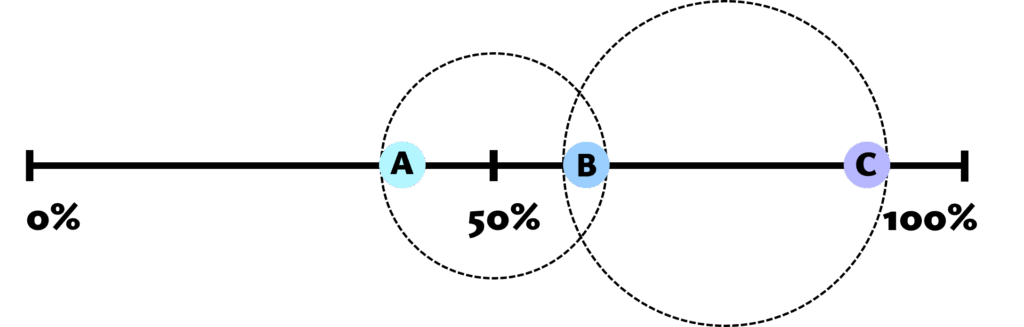
Bonus question/answer: Does ambiversion exist? No, but ambiverts could. Because traits are two opposite orientations, like introversion versus extroversion, there is no third -version. And because everyone already has a mix of traits, “ambivert” couldn’t just mean having a mix. However, the general classification or labeling of trait personality is a practical matter. For example, “ambivert” could be helpful in differentiating those who are absolutely (>50%) extroverted, yet relatively (<50th percentile) less extroverted than other people. The difficulties would be overcomplicating the language across factors, or accounting for different medians and different populations. It is likely preferable to reinforce the understanding that personality traits are spectrums and normalize using mild, moderate, or strong qualifiers.
Pulsive Traits
Traits are how pulsion is personalized. Pultrait™ is PersonalityTapestry™’s official version of pulsive triadic personality traits. Unlike the validated traits which interpretively describe behavioral patterns, pulsive traits postulates an underlying psychological function. Pulsive clarifies what traits are a prevalence or predominance of, but can be shortened to traits, given context. Pulsions orientate people in differing directions, and traits are the total of instances, as every individual is net pushed or pulled in one way or its opposite with more or less frequency. The terms extroverted or introverted are particularly suited, coming from roots meaning “to turn.”
If uninhibited by other factors, pulsive traits directly initiate and cause behaviors, patterns or trends of which become a person’s lifestyle tendencies. Because all psychological facets are interconnected, pulsive traits will also indirectly effect and be effected by affect and cognition. These can even be mental or cognitive behaviors or tendencies such as being driven to or engaging with a topic or interest in different ways. Pulsions, behaviors, and lifestyles are all closely connected, with traits underpinning specialized particularities, yet all exist with the multitude of other factors within and surrounding each individual.
Assessments
A questionnaire assessment for Pultrait™ has not yet been developed. In the meantime, take a validated trait assessment! Avoid websites that don’t state what inventory they are using or who is providing it. It is unnecessary to pay, as many are provided freely by qualified academics.
Remember that these questionnaires assess the answers you choose to give them, not necessarily your personality. Keep “pulsion” and “trait” in mind, looking in towards your inherent and irrational behavioral tendencies. Ignore complex, higher, or “realistic” decision-making, values or aspirations, and connotations or personal biases about the words used. What would happen “reflexively” if you didn’t check yourself? What would you revert to if there were no situational or secondary considerations?
| Model & Version | Questions & Results | If you prefer: |
|---|---|---|
| Big 5 IPIP-NEO available in other languages here! | 120-300 questions 5 factors 30 facets | The classic; recommended. From this you can determine your “pattern type,” a proposed alternative to grouping traits. Learn more about the public domain International Personality Item Pool (IPIP). |
| HEXACO-PI-R | 100 questions 6 factors 25 facets | The modern and multicultural |
| Big 5 BFI-2 | 60 questions 5 factors 15 facets | A quicker, simpler version |
| Analog to Multiple Broadband Inventories (AMBI) with equivalent scales for: HEXACO, Six Factor, Big 5, Temperament and Character, Multidimensional, Hogan, Jackson, and California Psychological | 181 questions 8 models | Multiple-in-one score estimates for a purview of less known models |
| MBTI* OEJTS | 60 questions 4 factors | A free alternative to the official MBTI*; not recommended. |
*For more information read our critique of typological trait models, including the MBTI and 16Personalities. The following are translations between major models, ranked top-down by strongest to weakest correlation with MBTI:
| MBTI* | Big 5 / OCEAN / CANOE | HEXACO |
|---|---|---|
| Extraversion (E) vs Introversion (I) | Extraversion (E) | Extraversion (X) |
| Intuition (N) vs Sensing (S) | Openness to Experience (O) | Openness to Experience (O) |
| Judging (J) vs Perceiving (P) | Conscientiousness (C) | Conscientiousness (C) |
| Feeling (F) vs Thinking (T) | Agreeableness (A) | Agreeableness (A) vs Anger |
| Neuroticism (N) | Emotionality (E) | |
| Honesty-Humility (H) |