Personality is multifaceted.
It saturates our psyches,
and spills into life.
Threads of all kinds intertwine
into complete, distinctive tapestries.


Family. Friend. Foreigner.

You.

Welcome to PersonalityTapestry™, a multifaceted synthesis of the human psyche. Home of triadic personality, we untangle three threads to the oft-hidden underpinnings beneath our:

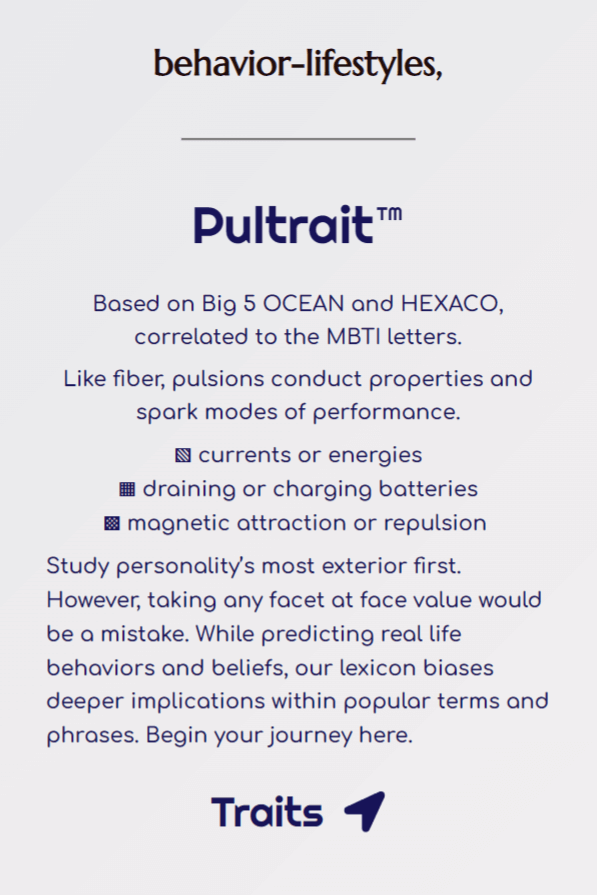
behavior-lifestyles,


Pultrait™

Based on Big 5 OCEAN and HEXACO, correlated to the MBTI letters.

Like fiber, pulsions conduct properties and spark modes of performance.

▧ currents or energies
▦ draining or charging batteries
▩ magnetic attraction or repulsion 

Study personality’s most exterior first. However, taking any facet at face value would be a mistake. While predicting real life behaviors and beliefs, our lexicon biases deeper implications within popular terms and phrases. Begin your journey here.

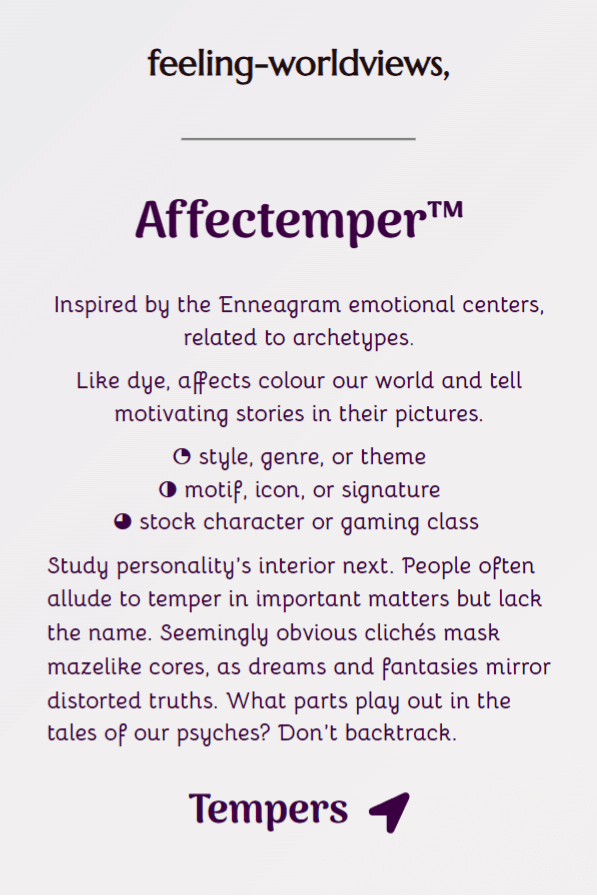
feeling-worldviews,


Affectemper™

Inspired by the Enneagram emotional centers, related to archetypes.

Like dye, affects colour our world and tell motivating stories in their pictures.

◔ style, genre, or theme
◑ motif, icon, or signature
◕ stock character or gaming class 

Study personality’s interior next. People often allude to temper in important matters but lack the name. Seemingly obvious clichés mask mazelike cores, as dreams and fantasies mirror distorted truths. What parts play out in the tales of our psyches? Don’t backtrack.

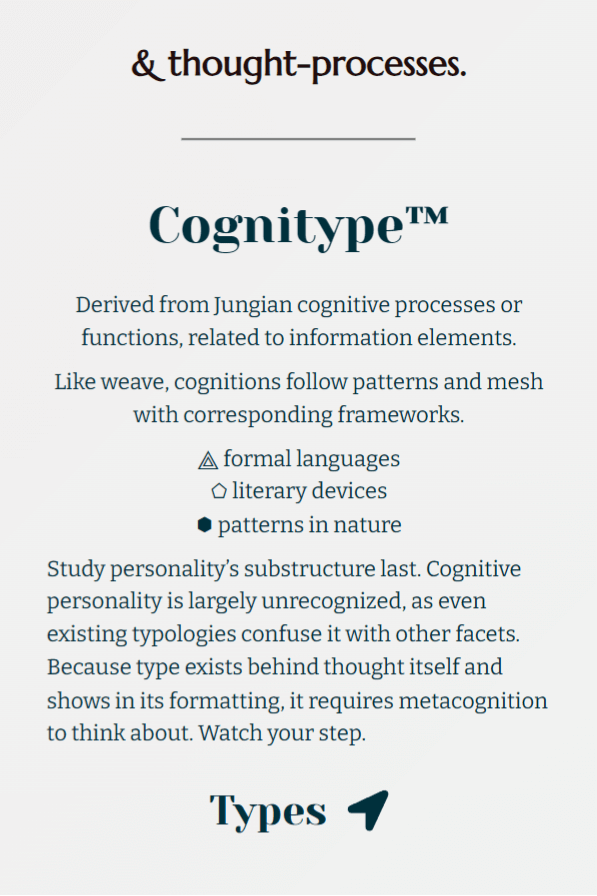
& thought-processes.


Cognitype™
Derived from Jungian cognitive processes or functions, related to information elements.
Like weave, cognitions follow patterns and mesh with corresponding frameworks.
⟁ formal languages
⬠ literary devices
⬢ patterns in nature
Study personality’s substructure last. Cognitive personality is largely unrecognized, as even existing typologies confuse it with other facets. Because type exists behind thought itself and shows in its formatting, it requires metacognition to think about. Watch your step.
Wait! Before you go, we recommend orientating yourself with the guide below. The whole of personality is vital to each facet. Read now, skim, or refer back as needed.

FAQ

On theory & systems:

Personality (noun): “A set of non-physical psychological and social qualities that make one person distinct from another;” etymology, from Latin persōna: “1. mask 2. character, personage, role 3. personality, individuality 4. (grammar) person;” morphologically, person plus -al “Of or pertaining to” and -ity “to form the noun referring to the state, property, or quality of conforming to the adjective’s description

The first step in understanding personality is… understanding what personality is. The definition of personality is broad and could technically include every unique factor of a person including their ability or even pathologies. However, these already have names. So, by process of eliminating what personality is not, what could constitute the “personality” itself? Essentially, personality means the more specialized and integral facets of a person’s psychology, of which everyone has some variants. But what exactly this is, is still unclear and is the subject of various conceptions of personality.

The Fingerprint of the Psyche

Here at PersonalityTapestry, personality simplifies and eases our interface with life into diversified strategies. This is personal to each person; however, every facet of an individual’s personality is derived from and shared across humans, as pieces of the semi-collective psyche. We use psyche to specifically mean the core, relatively stable facets of a person’s unique being, including personality but also personal history and development. This is who we are, in the “driver’s seat” of our existence — “you,” “me,” “us” — centering our whole psychology. Persona is the expression of the psyche. It has a negative connotation as being an inauthentic mask (which it can be), but it can also reveal the genuine face.

Reinverting Personality

Personality has depth in the sense that it is deeply ingrained in the psyche and largely subconscious at its roots. Personality is often confused with the colloquial sense of depth being “higher,” as in profound or valuable. Any association of personality with higher values (moral, rational, or otherwise) is indirect and tenuous. This is the opposite of what personality is inherently — deep as in irrational or lower level.

Personality has breadth in the sense that the facets at their purest, deepest level are highly nonspecific or general. Like a vast, empty container these facets can hold many various things depending on the multitude of other factors. These first principles can be harder to grasp due to the lack of tangible or actualized effects, at the furthest point from the detailed and personalized profile of a full personality.

Ability or Borderline Pathology?

Personality is the underpinning or undercurrent of oneself. As far as personality facilitates aptitude, the extent is like a “cheat code” or “icing on the cake” of ability. Personality can only assist preexisting capabilities. It may play a part of why people of the same general ability (such as intelligence, empathy, or physical coordination) have specific tilts or skews. However, because of its natural affinity and efficiency from inherent irrationality, personality is like a “double-edged sword,” wielding potential for both capacity and incapacity. These default, automatic tendencies are adapted to different environments and purposes. Like any adaptation, in unsuitable conditions these can be maladapted and dysfunctional. So be wary that “short cuts make long delays,” and remember that the primary factor of aptitude or natural skill is ability (not personality), that the primary factor of skill is ability and experience, and that all personalities can get to the same place.

Tapestry (noun):

  1. A heavy wovencloth, often with decorative pictorial designs, normally hung on walls.
  2. (by extension) Anything with variegated or complex details.

Personality is multivariate, of many factors. In our models, personality is trivariate or triadic, of the three major psychological functions. Although ideas like the triune brain are structurally and evolutionarily incorrect, and histories of tripartite faculties or activities have come in and out of favor with varying terms, the division of psychology into three major functions, in our terms — pulsion, affect, and cognition — is approximately, functionally accurate.

Three psychological functions → Three personalities thereof.

It is commonly accepted without clarification that different models cover different facets of personality, along with different conceptions of personality itself. PersonalityTapestry’s original triadic personality concept clarifies the subject and scope of personality. Each psychological function is personalized — creating three independent domains of personality. The “fiber” (pulsive traits), “dye” (affective tempers), and “weave” (cognitive types) come together forming the “tapestry” (triadic personality).

This “tapestry” is also analogous to our view of personality as an elaborately complex, twisted, tangled, and serpentine characteristic of human psychology. Stepping back, through every loop and knot, color and texture, the intricacies blend into a whole. Through this, the underlying facets become obscured.

Rather than carefully tracing and untangling the threads which exist across tapestries, non-academic models especially tend to cut pieces out of the tapestry, or compare whole tapestries to one another. This creates mixed models, confusing and conflating different facets of pulsion, affect, and cognition, of traits, tempers, and type — models which group more and less similar tapestries together and miss entire combinations in less stereotypical (or ideologically ignored) tapestries.

“Tapistrifying” other personality models

PersonalityTapestry’s models are the first and only current models which were made for and from the premise of triadic personality. In this they are ideally and explicitly suited. However, the triadic concept stands on its own. We encourage its concept in reevaluating and adjusting other models and our own. Are there other major psychological functions; another number than a triad? Is personality particular to each or comprehensive to all? What is personality? Regardless of the model, these fundamental questions must be answered, upon which entire models depend. Especially with personality terms having multiple potential meanings, this helps clarify what is meant throughout a model. It also provides a metric against which claims are held accountable, argued and tested, before getting too deep into specifics.

One benefit of cleanly distinguishing the personality triads is the freedom for multiple personality models to be applied in any combination with one another. So yes, any type could have any temper which could have any traits. There might be associations, but no limitations.

Tens to hundreds of thousands?

If we multiplied the standard Big 5 traits (32 combinations) with a Jungian type (8), that would be 256 personalities. Enneagram would raise this to 2,048. However, because these models overlap, many of these aren’t necessarily valid combinations. Instead, if we calculate using our 6-factor traits (64 combinations), tempers (32), and types (16), we can more confidently say there can be 32,768 base personalities assuming these models are valid. If we additionally assume sub-triads, such as our 4 sub-types, we could get to 131,072.

Not quite…

Furthermore, this only counts delineations, not exactions. Both 60% extroversion and 80% extroversion are “extroverts.” If you calculated every perfect degree, we can conclude personality as it exists in each living, breathing person is likely as “unique as a fingerprint” (even if evasive of classification or human perception and so relatively irrelevant).

The map is not the territory; the word is not the thing.

From approaches & designs:

Science is what we know, and philosophy is what we don’t know.

About causes & correlates:

Until you make the unconscious conscious, it will direct your life and you will call it fate.

For application & meaning: